Introduction to Why Empty Multiplication Charts Are Taking The Educational World By Storm
If you are looking for information about Why Empty Multiplication Charts Are Taking The Educational World By Storm, you have come to the right place. Subscribe to our Youtube Channel! Follow us on instagram: Tiktok: ...
Why Empty Multiplication Charts Are Taking The Educational World By Storm Comprehensive Overview
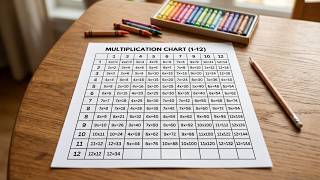
Educators across the United States are replacing dense times‑tables with stark, empty multiplication charts, and the shift is reshaping classroom practice. By removing pre‑filled products, these charts compel students to engage actively with the multiplication process, fostering deeper conceptual understanding and reducing dependence on rote memorization. Early adopters report heightened inquiry, improved number sense, and a measurable drop in calculation errors. An empty multiplication chart presents the familiar grid of row and column headers—usually 1 through 12—but the intersecting cells are left blank. Instead of a static table of products, learners fill each cell during problem‑solving activities, peer tutoring sessions, or guided discovery tasks. The format preserves the visual scaffold of a traditional chart while eliminating the “answer key” that can shortcut the learning process. The move aligns with research that emphasizes active cognition over passive reception. When students must generate each product themselves, they are forced to retrieve multiplication facts from memory, apply distributive reasoning, or use patterns such as the commutative property. This active retrieval strengthens neural pathways and encourages students to notice regularities—like the consistent increase of 10s across a row.
Summary & Highlights for Why Empty Multiplication Charts Are Taking The Educational World By Storm
- Moreover, the empty chart acts as a visual prompt for the “why” behind each calculation. Teachers can pose questions like “Why does 7 × 8 equal 56?” and guide discussions toward strategies such as breaking 7 × 8 into (7 × 5)+(7 × 3). The chart’s openness also supports differentiated instruction: advanced learners can explore multiple solution paths, while emerging readers receive structured practice.
- Applying a Five‑Why technique to the adoption of empty charts reveals layered benefits:
- Why improve student engagement? Blank cells require learners to participate rather than observe.
We hope this detailed breakdown of Why Empty Multiplication Charts Are Taking The Educational World By Storm was helpful.
Frequently Asked Questions about Why Empty Multiplication Charts Are Taking The Educational World By Storm
Q: What is the most accurate information about Why Empty Multiplication Charts Are Taking The Educational World By Storm?
A: Our platform aggregates the most comprehensive and up-to-date insights, ensuring you get relevant details about Why Empty Multiplication Charts Are Taking The Educational World By Storm.
Q: Why is Why Empty Multiplication Charts Are Taking The Educational World By Storm trending right now?
A: Interest in Why Empty Multiplication Charts Are Taking The Educational World By Storm has surged recently as more people seek reliable resources, related media, and detailed analysis.
Q: Where can I find related media and updates for Why Empty Multiplication Charts Are Taking The Educational World By Storm?
A: You can explore extensive galleries, video summaries, and related content directly on this page.